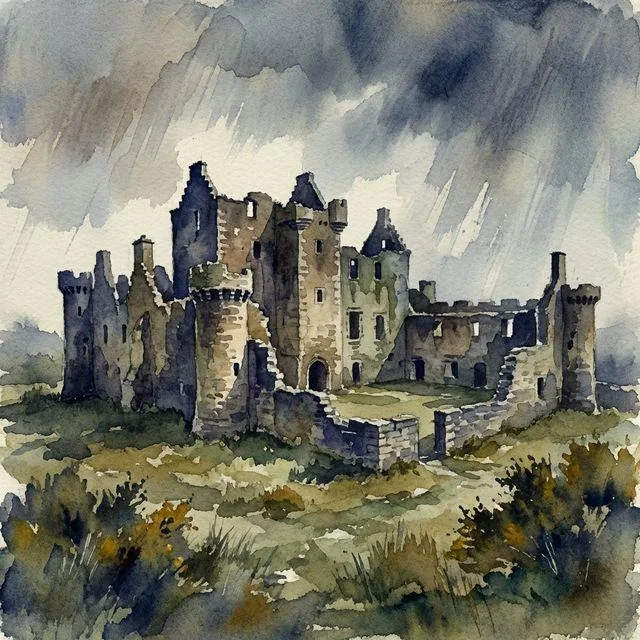
Craigmillar Castle stands two miles south-east of Edinburgh’s Old Town, on a low rise above what was, in the early twentieth century, newly built housing at Niddrie Mains. The castle is fourteenth-century in its oldest parts, extended by the Prestons and later by the Gilmours, and has been a managed ruin since 1946. Its great tower and inner courtyard survive largely intact. The outer walls enclose a considerable area of ground.
In the spring of 1934, residents of the Niddrie Mains estate began reporting a figure in the fields and lanes between the housing and the castle.
The reports were gathered by The Sunday Post and published on 5th May 1935, under the headline Edinburgh Ghost With Spurs.
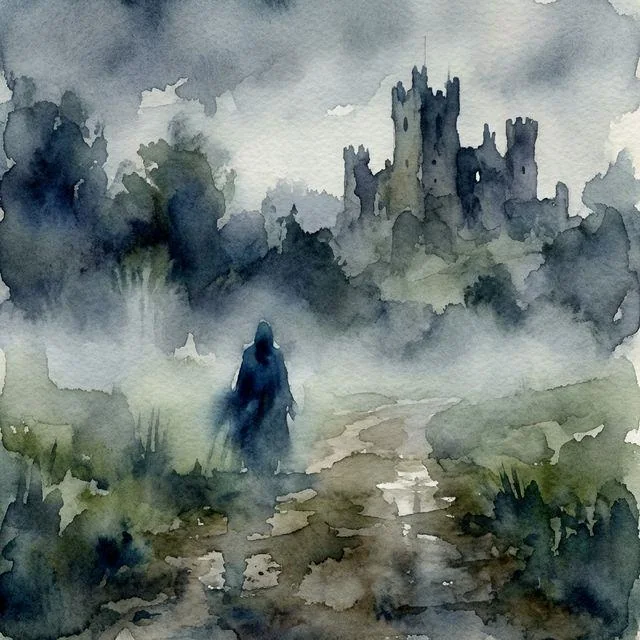
The figure was described as wearing a long, dark blue hooded cloak. It had, in the words of the published account, a mass of tangled black hair falling over the forehead. It wore heavy riding boots. The boots had spurs.
It was described as gliding rather than walking. Several witnesses used that word independently.
Its eyes, when seen directly, were described as gleaming. The word used in the published account is menacingly.
By the time the article was published, a group of residents had already been organised in Niddrie Mains to investigate the sightings. The group went out on more than one occasion. The figure was not caught. It was, however, observed on at least one of these occasions, retreating in the direction of the castle, and then was not observed any further.
The Sunday Post account does not record anyone pursuing it inside.
The figure has not been reported in the fields since 1935. No account located for this record describes it in the lanes, on Peffermill Road, or anywhere in the surrounding area after that date.
It has been reported inside the castle.
The accounts gathered from within the castle walls do not describe a figure in a blue cloak. They describe a presence in the inner chamber of the great tower — the room known historically as the room in which, on an evening in October 1566, a document was signed by a group of Scottish nobles agreeing to the murder of Henry Stuart, Lord Darnley, husband of Mary Queen of Scots.
The document is known as the Craigmillar Bond. The signatories included the Earls of Argyll, Huntly, Bothwell, and Maitland of Lethington. Mary herself was at Craigmillar at the time of its signing, recovering from illness. Whether she was aware of the Bond or endorsed it is not established.
Darnley was murdered at Kirk o’ Field in Edinburgh on 10th February 1567. The method was an explosion. Whether he died in the blast or was strangled beforehand is not established.
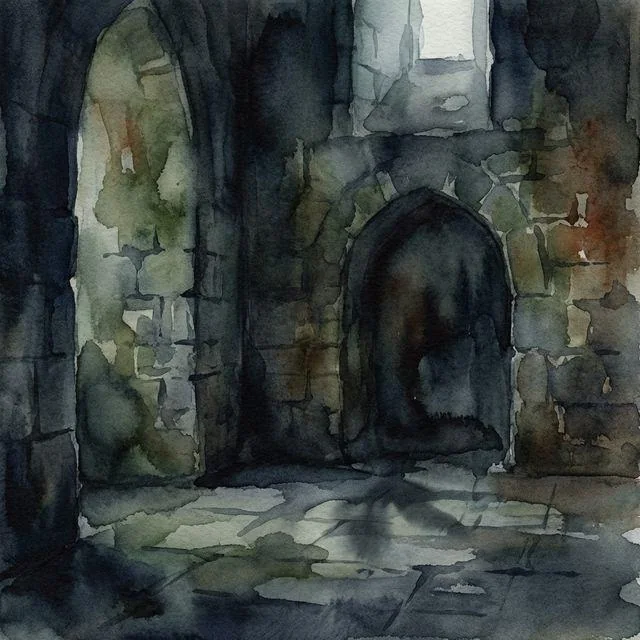
The accounts from within the great tower do not attempt to identify the presence reported there. They describe cold. They describe the specific sensation, reported consistently enough across unconnected accounts to be worth noting, of being watched by something that has been in the room longer than the visitor and expects to remain there after the visitor has gone.
One account, submitted in writing by an unnamed source, provides more detail. The writer had been sitting in the inner chamber alone, the rest of the castle empty at the end of a visiting day. He describes a sound from the far corner of the room. Not footsteps. Not a voice. He describes it as the sound of a man shifting his weight — the small involuntary sound of someone who has been standing still for a long time and has moved, just slightly, without meaning to.
He left the room. He does not describe looking at the corner before he left.
The figure on Peffermill Road was always moving in the same direction.
Toward the castle. Into the castle. Into the maze-like ruins, as the Sunday Post described them, where it could not be followed.
What it was returning to, or returning for, was not established in 1934 or 1935.
It has not been established.
The inner chamber of the great tower is accessible to visitors during opening hours. The corner in question is in the north-east. In most lighting conditions, it is the darkest part of the room.
No record confirms the accounts described.
The castle remains open to the public.