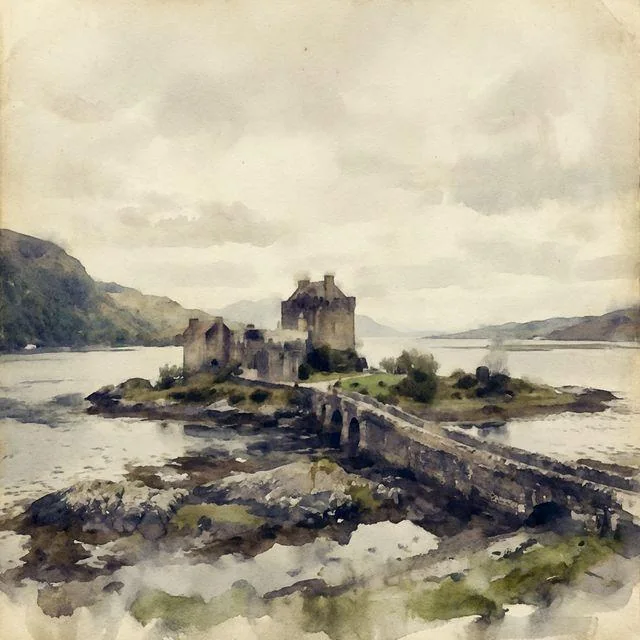
Eilean Donan Castle occupies a small island at the confluence of three sea lochs — Loch Duich, Loch Long, and Loch Alsh — connected to the mainland by a stone causeway. The current structure dates substantially from a restoration completed between 1919 and 1932 by Lieutenant Colonel John MacRae-Gilstrap, working from a surviving floor plan. The castle had stood largely in ruin since 1719. It has been open to the public since 1932 and is among the most visited buildings in Scotland.
Reports of activity have been recorded after closing.
In April 1719, forty-six Spanish soldiers were garrisoned at Eilean Donan in support of the Jacobite uprising. The castle held a substantial magazine of gunpowder, distributed between two outbuildings. On the 10th of May, three British frigates — the Worcester, the Enterprise, and the Flamborough — entered Loch Duich and opened fire. The bombardment lasted several hours. When it was over, the magazine was detonated, the castle reduced to its outer walls, and the surviving Spanish soldiers taken prisoner.
The number of dead is not precisely recorded.
The area now designated as the castle’s exhibition room occupies the footprint of one of the original outbuildings. Staff members at the castle have, over several years, reported footsteps in this area after closing — measured, even, heard when the building is otherwise empty and secured. The reports have been acknowledged by staff. The soldier associated with these accounts has been given the name Carlos by castle staff. No historical record identifies any individual by this name among the 1719 garrison.
He is described in accounts accumulated over several decades as headless. He is described as carrying the head.
This detail is consistent across accounts that have no apparent shared origin. It appears in descriptions gathered from visitors who had no prior knowledge of the castle’s reported hauntings. It appears in staff accounts given independently of one another. The consistency is notable.
No explanation has been recorded.
The bedroom on the upper floor is associated with a figure known as Lady Mary. She has been reported there repeatedly. Her identity is not known. The name Mary has been attached to her by tradition. Her identity is not known. Whether she is connected in any way to the castle’s documented history — to the MacKenzies, the MacRaes, the Jacobite period, or any other era — has not been established.
She has been seen in the room. She has been seen from the doorway of the room, standing at the window. On at least one occasion, she has been reported in the corridor outside the room, facing the door, as though she had just come out or was about to go back in.
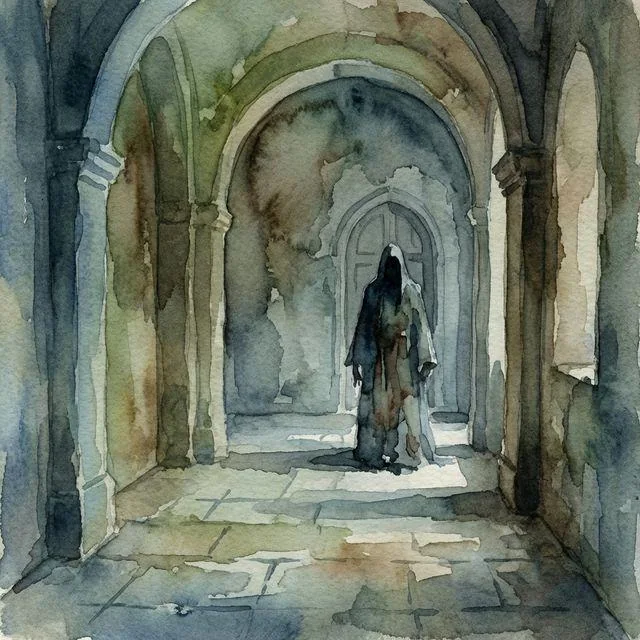
These accounts share one specific detail worth noting. In each of them, the figure is described as dressed in a manner inconsistent with any particular period. Not obviously old-fashioned. Not in costume. Dressed in a way that does not immediately announce its era.
This detail differs from other accounts of this kind. Apparitions tend to arrive in period dress, or are at least described that way. The absence of that detail in the Lady Mary accounts is not easily explained.
In 1331, Randolph, Earl of Moray, had fifty men executed at Eilean Donan. Their heads were displayed on spikes along the castle walls. The record notes this without further detail.
The island itself carries older associations. Local tradition holds that Eilean Donan was used as a burial site for the Otter Kings — figures from Gaelic mythology, royal creatures of the water whose silver-white pelts were interred here upon their deaths. The name of the island may derive not from the bishop Donnán, as is commonly stated, but from the Gaelic cú donn, meaning the brown dog, or the otter.
These are legends. The site has been associated with burial.
The restoration from 1919 to 1932 was extensive. MacRae-Gilstrap worked from a single surviving floor plan and rebuilt the interior almost entirely from scratch. During the work, certain items were found in the rubble and beneath the floors that are not described in detail in the available records. The restoration records note that the material was examined and the work proceeded without incident.
The first reported sighting of Carlos occurred shortly after the castle opened to the public in 1932.
Whether that timing is significant is not recorded.
The footsteps in the exhibition room continue to be reported. Castle staff treat them, by all available accounts, with the matter-of-fact acknowledgement of such reports.
They hear them. They note them. They go home.
In the morning, the castle is as it always is — open to the lochs on three sides, the causeway connecting it to the mainland, the mountains of Kintail rising behind it, the surrounding water unchanged.
No record confirms the accounts described.
The castle remains open to the public.