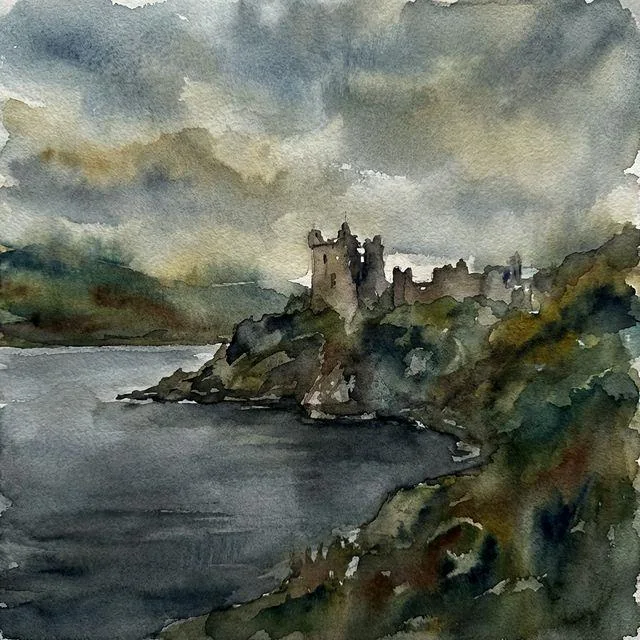
Urquhart Castle stands on a rocky promontory on the western shore of Loch Ness, eleven miles south-west of Inverness. It has been a fortified site since at least the sixth century. The current ruined structure dates principally from the thirteenth to the sixteenth centuries. In 1692, the castle was deliberately destroyed by its own garrison to prevent its use by Jacobite forces. The Grant Tower, the gatehouse, and sections of the curtain wall remain standing.
The loch at this point is approximately two hundred and thirty metres deep.
A record made in 1893 by the historian William Mackay, in his study of Urquhart and Glenmoriston, notes the following local belief without attribution to any individual source:
It is believed in the Parish that there are two secret chambers underneath the ruins of the Castle — the one filled with gold and the other with the plague. On account of the risk of letting loose the pestilence, no attempt has ever been made to discover the treasure.
Mackay offers no opinion on the claim. He records it and moves on.
No subsequent investigation has located either chamber. No record consulted for this account specifies when the belief originated, or what event, if any, gave rise to it. It appears in Mackay’s text as something already old — a piece of local knowledge so established it requires no defence and no explanation.
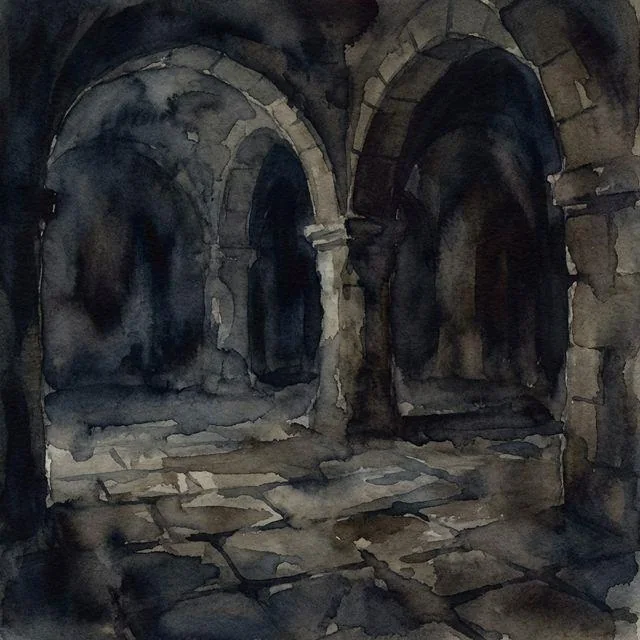
The castle was excavated at intervals throughout the twentieth century. No official report from any of these excavations references the discovery of sealed subterranean chambers. Whether this absence is significant is not recorded.
The sounds reported from beneath the dungeon floor are documented in a small number of accounts, the earliest identified for this record dating from the late eighteenth century. They are described consistently: a rhythmic thumping, heard through the dungeon floor, as though originating from some space below it. The accounts gathered from the period when the castle was still intermittently occupied describe the sound as most audible at night, and especially when the loch was still.
One account, whose source could not be fully verified, describes prisoners in the lower cells refusing to sleep on the floor. It does not elaborate.
The relationship has not been established.
In 565 AD, the monk Columba visited a settlement on the shore of Loch Ness. His chronicler Adomnan, writing more than a century later, records that Columba encountered a creature in the water near this place — described as an aquatilis bestia, a water beast — and commanded it to withdraw. The creature, Adomnan writes, retreated.
The site of this encounter is not precisely specified in the text. It is in the same reach of the loch as the promontory on which the castle was later built.
Gaelic tradition names the creature of Loch Ness not as a monster but as the Each Uisge — the water horse. The Each Uisge is described in Highland folklore as a shape-changing creature capable of appearing as a horse or, less frequently, as a man. It is distinguished from the kelpie by one consistent detail: the kelpie haunts rivers and streams, while the Each Uisge belongs to deep, still water. The loch at Urquhart Bay is among the deepest points of Loch Ness.
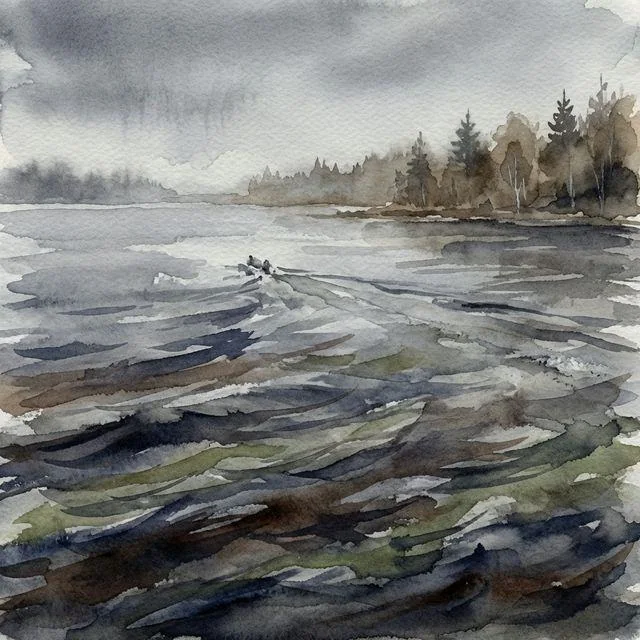
The accounts gathered from visitors and staff at the castle’s current interpretation centre include a small but consistent category of sighting reports. They do not describe a creature. They describe a disturbance on the surface of the loch, visible from the castle, at a point some distance from the shore. The disturbance is characterised by movement in a defined direction and apparent purpose, against the prevailing water drift.
The castle does not present these accounts as evidence of anything.
They are not dismissed, either.
The garrison carried out the deliberate destruction of 1692 before they withdrew. The east wall of the tower house was mined and brought down. The operation was thorough. Those who carried it out knew the castle well.
No account survives from any member of the garrison describing what, if anything, they found in the course of the demolition work. No inventory of the castle’s contents at the time of destruction has been located. What was in the lower rooms when the walls came down is not recorded.
What was in the chambers below — if the chambers existed, if they exist still — is equally unrecorded.
Mackay’s note from 1893 suggests that by that point, no attempt had ever been made.
The phrasing he uses is precise on this point: no attempt has ever been made.
Not that the chambers were not found. Not that they were searched and proved empty.
That no attempt was made.
The distinction is not addressed. It is not remarked upon by Mackay, who was a careful historian and chose his words with care.
The castle is managed today by Historic Environment Scotland. The grounds and tower are open to visitors. The dungeon is accessible.
The floor of the dungeon is stone.
No record confirms the accounts described.
The castle remains open to the public.